Showing posts with label Groton. Show all posts

Sunday, December 1, 2019

On A More Effective RTM

The unique form of government in Groton, Connecticut provides unique opportunities for transparency and bringing forth the best ideas of the people. Over more than two decades of serving in numerous non profit and governmental organizations, I have seen all manner of government and governance structures. Our unique combination of a Town Council and a Representative Town Meeting (RTM) provides some very interesting benefits if the RTM takes advantage of them.

Most members of the RTM are simply citizens who have decided to become more involved in their community. They do not have particularly deep knowledge of the issues or structure of town government, and this is a beautiful thing. It is beautiful because it means that the average RTM member is asking the very same questions that their constituents have, and they are asking them on camera where that constituent can watch the questions and answers right there on TV (or Youtube). This is an amazing resource for transparency.

Bringing my outside experience to my time on the RTM, I have three thoughts on how the RTM can leverage its existing resources to serve as an even greater asset to our community: fact forward debate, embracing its role in transparency, and a creative engagement committee. I write them so that whoever is the next moderator of the RTM might consider putting them in place to create a more effective and efficient body.

Fact Forward Debate
Robert’s Rules of Order outlines a method for presenting, debating, and voting on motions which assumes that the person raising the motion is the first person advocating that motion. Because the RTM is more reactive on most issues, most main motions that the RTM votes on are initiated by the Town Council. The issue will be reviewed by the relevant committee, then the committee chair will report out the minutes of the meeting in which the motion was discussed. There is then an opportunity for questions from RTM members prior to voting.

While the minutes describe a vigorous discussion of the matter at hand, the nature of minutes can make it difficult for members to get a complete understanding of the issue, resulting in a lengthy set of questions from members as they try to understand the basic outline of the issue at hand.

A more efficient format would be to have either a member of town staff or a member of the Town Council, or even a member of the RTM, provide a clear, factual presentation of the effect of the proposed action and reasons why it should be adopted.

This is doubly important in the case of ordinances, which the RTM does not even formally discuss until a motion to veto is made. It makes little sense that a member has to rise to veto an ordinance simply to learn the background and reasoning behind the ordinance. A brief explanation of the ordinance and its reasoning could save 30-60 minutes of debating and voting on an ordinance that nobody actually wants to veto.

This initial presentation of only a few minutes could replace what is often a half hour or more of questions that are meant to simply clarify the issue. This will allow questions and debate that does occur to be more specifically directed and efficient. It will replace what is often a sense of confusion about the issues before the body with a sense of confidence.

Embracing the RTMs Role In Transparency
The Charter allows the Moderator to cancel any meetings at which there is not “business” to consider. But what is “business?”

Some suggest that business is anything that we are required to vote on, but if the voting is the only important part, why do we spend 60-90 minutes on reports from town staff and committee liaisons?

In an era of limited resources of local media to cover local government, the RTM’s ability to ask questions of our town staff and leadership and get insightful answers is one of the best resources to inform our citizens available to us. The reports portion of the meeting is every bit as vital to the value the RTM provides as any funds appropriation or ordinance review.

The RTM has the same power as a congressional hearing: the power to ask questions and get answers in a public forum. In many towns, decisions are made and nobody knows how they are made or what is happening. Groton’s RTM provides citizens a unique and wonderfully democratic mechanism to pull back the curtain of town government. But it only works if the RTM meets.

Depending on the way the Town Council’s activity falls, the RTM sometimes cancels a number of meetings. This past year, for example, we did not meet in July, August, or October. This made it difficult for members to get answers to key questions they were seeking. While staff is quite good about communicating with RTM members directly, the transparency of those answers being in a public forum is extremely valuable.

I would suggest that there is important business at any meeting where any member has an issue that they’d like to get answers on. Sure, this may mean that there are meetings at which nothing is voted on. That means that the RTM could fulfill its valuable duty of providing transparency in a meeting on an hour or so. Nothing wrong with that.

Creative Engagement Committee
The town of Groton is ably managed by a team of skillful and honest professional staff, and I believe that every department is run by leaders who absolutely seek to provide serve at the best of their abilities. Most of the issues before the town are not Right versus Left or otherwise ideological, but are more often simply a question of whether or not someone has looked closely enough to see if there’s a better way to do things.

The members of the Town Council are, by the nature of their duties, up to their elbows in the regular functioning of the town and tend not to have the time to dive into various elements of the town to find exciting new solutions to old problems.

On the other hand, RTM members, by their very outsider nature, have the ability to bring fresh perspectives. In the previous term, the RTM operated entirely reactively, but there is no reason it could not operate more proactively.

Naturally, some members are more interested in diving in and getting their hands dirty than others, so it would not make sense to ask the existing committees to take on additional work. I would suggest creating a Creative Engagement Committee. This committee would be comprised of volunteers interested in getting into the weeds to really see how things work and how they might work better.

This would not be an investigative committee to catch wrongdoing. Rather, it would be a resource for the town, bringing fresh ideas and perspectives. The very lack of legislative authority of this committee would be an asset. If one is not always thinking in terms of new legislation, one is often freer to have more creative ideas. Many solutions this committee might find could simply be executed by the department head.

Many of the greatest innovations have some from an outsider coming in and saying, “hey, why do we do it this way?” We have a pool to citizens who are interested in getting involved. Why not let them?

Three Ideas
Based on my considerable experience in other organizations and my two years on the RTM, I feel that these ideas would streamline meetings, improve the RTMs effectiveness at serving the people, and help make the town more efficient. All three ideas can be executed within the authority of the Moderator without any changes to the RTM rules or the Charter.

I look forward to working with the RTM for another two years as we serve our neighbors together in this wonderful and unique government institution.

Michael Whitehouse is a member of the Groton Representative Town Meeting serving the 4th district.

Sunday, March 31, 2019

Fiscal Responsibility versus Austerity in Groton

The North Stonington Road Bridge... at least what used to be.
You go to a nice restaurant and you order a fancy meal that costs $24.17. The food comes out, but it's a little slow to get to your table. Your silverware isn't quite clean. The vegetables are okay, but clearly not fresh, probably frozen. Your experience is not terrible, but it's mediocre.

The vegetables were frozen because that cost a little less than fresh. They laid off the more experienced dishwasher and hired a less expensive one to save money. They are also short one guy in the kitchen, again to save money, and that's why your food was slow.

They made the cuts so they could reduce their prices. Had they not done so, the price would have been $24.74.

I suspect that if you were given the choice of the $24.17 mediocre experience or the $24.74 excellent experience, you'd pick the excellent one.

One Town's Fiscal Choice

That is the choice that the town of Groton, Connecticut faces in this year's budget cycle. The current intention is to hold the mill rate the same as last year's at 24.17. (The mill rate is the rate per thousand that a property owner pays in taxes.)

But there is a cost to this conservation:

  • $1.5 million will be drawn from the general fund
  • The North Stonington Road Bridge will not be repaired
  • The Bill Memorial Library and Mystic & Noank Library will be cut, and, in later year, be completely unsupported by the town
  • The new community center will continue to have unusable water and a leaky roof.

A Town In Decline

A sign of decline.
When a movie director is trying to show that the world the story takes place in is in decline, they will show broken things. They will show the once nice things that the society could not longer afford to maintain. "We have to take the stairs. This building used to have an elevator, but it broke years ago and no one can fix it." OR "We'll have to go the long way around. There used to be a bridge, but it was washed out in a storm years ago and we can't afford to fix it."

Every "Bridge Out" sign, every closed library, every "park closed" sign is a monument to the decline of a community. It is a celebration of past greatness and present failure.

For Groton to fail to repair it's bridge, to underfund the libraries, to not have a properly maintained community center, it is saying "we used to have nice things, but we can no longer afford them."

That is a town in decline. Perhaps the town really is so poor that austerity is the only option, and visible decline the necessary cost of this, but I'm not sure everyone would agree.

Austerity Versus Investment

The cost to fund the libraries is 0.1% of the total town budget, so let's focus more on the larger maintenance issues.

The argument for holding the mill rate level is that a half mill increase this year could lead to one the next year and the year after that. After 20 years, the mill rate goes from 24 to 34, and that's not a good thing.

This sidewalk on 184 has been closed for some time.
On the other hand, Groton has a bridge out, an unusable sidewalk, etc. If the mill rate is held level at the cost of failing to fix our infrastructure as it wears out, then there is another danger. What if the mill rate stays the same but the number of highly visible infrastructure failures increases by one every year. Twenty years from now, you'd have a low tax rate and 20 unusable bridges and sidewalks and parks throughout the town.

When you have 20 "bridge out" and "park closed" signs around town, people notice. Home buyers notice. Property values fall. Tax revenues fall. Mill rates must be increased to compensate.

Under austerity, you still have to raise the mill rate and you end up with a town full of signs of neglect and decay.

What's the Cost

One mill point converts to $3,686,117 of revenue. The proposed cut to the library is about $38,000. Other cuts to agencies which provide services to Groton residents come to about $30,000. Groton's share of repairing the North Stonington Road Bridge would be $300,000. Substantial improvements could be made to the community center for $250,000.

The total cost to fully staff the kitchen, to use our example above, would be $618,000 or 0.17 mills. If we want to do it without taking money from the general fund balance, it would be 0.57 mills.

$550,000 of this would be one time capital costs. $1,500,000 would remain in the general fund to use in future years when we have harder times. Only $68,000 of this is recurring budget items.

For an owner of an average $200,000 house, the property tax based on these rates would be:

Austerity: $4,834
Fully Funded: $4,868
Fully Funded without using town savings: $4,948

Under the proposed austerity, defunding the libraries, the supporting agencies, failing to repair a failed bridge, and leaving the community center in need to improvements, the average homeowner would save $114 per year.

One hundred and fourteen dollars. To the average family.

There is a line between fiscal responsibility and dangerous austerity. I think we can see where that line is.

What You Can Do

The Town Council of Groton is a group of tremendously hard working and dedicated volunteers. They work with the best interests of the town in mind and want to be accountable to the taxpayers. They are pushing down this path of austerity because that is what they believe that the residents want. The loudest cries they hear are from those who want taxes cut no matter what the cost, and if that is what you want then you are being heard.

On the other hand, if you would like to see the bridges fixed, the community center improved to the level a town like Groton deserves, the libraries and agencies funded to provide great services to you and your neighbors and you understand it may cost a few dollars more in taxes to get these benefits, please contact you Town Councilors and let them know that you believe that 0.57 mills is a small price to keep all the nice things in Groton.

Their contact information can be found here.

Closing Thought on Outside Agencies

The Mystic & Noank Library, the Bill Memorial Library, and other organizations called "outside agencies" are being cut by 25%. The argument is that the money should stay in the town. This is misguided argument.

The two association libraries cost the town a mere $125,000 combined and offer tremendous services funded by donors, other towns, and a variety of other sources. Groton receives millions of dollars of value for tens of thousands of dollars of expense.

These so called outside agencies are simply agencies that are not operated by the town but provide town services. The town gives them money because the services they provide would be profoundly more expensive for the town to provide internally.

When a cut of $100,000 of expense runs the risk of losing $1,000,000 of value, it should be very closely considered. This money does not leave the town. It stays in the town and it brings friends.

Michael Whitehouse is member of the Representative Town Meeting representing the 4th District of Groton, Connecticut.


Sunday, November 4, 2018

Will Your Vote Count on the Budget Referendum?

In a recent article, I discussed some fundamental and serious flaws with the proposed charter for Groton, CT. Today, I'm going to explain how the referendum in the new charter does not actually give voters any control over the budget and can and will be completely ignored.

The proponents of this new charter believe that the budget referendum will somehow be the cure for every problem that Groton has. Groton certainly has it's challenges, and reasonable people can differ on the efficacy of a budget referendum to fix them, but to do that the referendum must have the power to control the budget, and due to a flaw in 9.12.6.6 of the proposed referendum, the referendum does not actually control the budget.

9.12.6.6 Interim Budget and Fixing the Tax Rate In case a Budget is not approved by June 30, the budget submitted by the Town Council per Section 9.10.3 shall be utilized as an interim budget until a new Budget is approved by referendum. Within three (3) business days after an interim budget is approved goes in to effect, the Town Council will set a mill rate that shall be sufficient, with the income from other sources, to meet the estimated expenses of the Town for the next fiscal year.

So there's an interim budget. That's a good solution to the budget chaos that neighboring towns have, right?

Well, yes, it does prevent budget chaos, but it also removes the teeth from the referendum. Let's look at an example.

Image result for useless
Whatever the charter was supposed to do, it doesn't do it.
Since the budget referendum must be held every two weeks after the initial vote fails, 9.12.6.6 effectively says that there can be up to three referendums before the interim budget takes effect.

Let us imagine that the Town Council puts up a budget of $45,000,000 for an initial vote. The referendum fails, and the Town Council makes a good faith effort to offer a new budget with deep cuts, this time $43,000,000. It fails as well. So, the Town Council makes a third effort with a $41,000,000 budget. A $4,000,000 cut means a lot of cuts in services, but the people are speaking and they are trying to listen.

The people vote no again. June 30th comes around and 9.12.6.6 comes into effect. The first, $45,000,000 budget goes into effect and the Town Council sets a mill rate accordingly.

If your car keeps breaking down, you fix the car.
You don't throw away your tool box.
The initial budget that the Town Council wanted is now in effect. Why would they ever put forth another budget for vote that was lower? If no budget ever passes, the $45,000,000 sticks, and the Town Council has all the power to determine what gets voted on.

After the Town Council offers $45,000,000 a couple more times, the referendum will either pass when people realize it is already in effect, or it will keep failing... until it passes because people realize it's already in effect.

The following year, there's no reason for the Council to mess around. They'll just put forward the budget they want in the first place, and it doesn't matter if it passes or fails because after three votes it goes into effect anyway.

Of course, this exercise in fake democracy costs taxpayers about $100,000 every year, or $400,000 over the course of a Town Council's four year term. That's the same amount it cost to get the Fitch Community Center up and running. That's a lot of money to waste to pretend the public can influence the budget.


Ultimately, the check of the RTM and it's reduction of 1-2% every year from the budget is gone. The Board of Finance is powerless. The referendum is easily ignored. In any system with no checks and balances in place, the natural result is budgets slowly but inexorably growing.

Spending money on a referendum that doesn't matter.
Yeah, it's kind of like that.
Whatever this new charter was intended to do, it doesn't do it. The people of Groton trade away their representation through the RTM for a vote in a referendum that ultimately doesn't matter. It doesn't matter if you like big government or small government, lower taxes or more services, there is no possible agenda you could have that is served by this poorly written and deeply flawed charter.

The only reasonable vote on the proposed Groton charter is NO.

Friday, November 2, 2018

The Christmas Tree Scenario


I have been writing a series of articles about the proposed charter revision for Groton, Connecticut. This article gives a good understanding to start from if you are not familiar with the issue.

One of the great promises of Groton's proposed Charter Revision is that of better control of the budget, but is that promise really true? I'd like to discuss what I call The Christmas Tree Scenario.

Let us imagine a town called Charter Town. Charter Town is a town of 40,000 people that operates under the Charter as proposed.

We have been assured that the public will have sufficient knowledge of the budget to make an informed decision, and we're accepting that assumption for this scenario. In fact, we're going to assume that the public is not only fully knowledgeable but that the people of Charter Town are magically able to understand the importance of every aspect of the budget and know the motivations of the Town Councilors.

The optimum budget for Charter Town this year is $100,000,000, and everyone would agree to that budget because everyone knows it's the right number.

But Councilor A would really like to see the town dock renovated, which will cost $110,000.

Councilor B is okay with that, as long as she can get a new sound system into the high school auditorium for $110,000.

Councilor C really wants to see another police officer hired, which will cost $110,000.

Etc. Etc. With all 9 Councilors each adding their own $110,000 addition.

We call this the Christmas Tree Scenario because in certain situations, everyone will want to hang their own ornament on the Christmas tree.

None of these little additions are inappropriate, and some would be nice to have, but they are also not necessary. They are what is often referred to at the Groton RTM as "nice to haves." But each little Nice to Have adds up. In this case, to a million dollars.

9 councilors, each adding their own small pet project add $1,000,000 to the budget, turning an optimum $100 million budget into a $101 million budget: a modest 1% increase.

The well informed and rational voters are faced with a choice. Should they approve this budget, recognizing that the small additional expenditures are actually nice to have and don't cost that much, or should they vote to fail the budget, incurring the additional expense and uncertainty of one or more potential revotes?

If Charter Town had a Representative Town Meeting reviewing the budget line by line, it could excise the unneeded line items and bring the budget down to the $100 million optimum budget, but having only a referendum, they can either say yes or no to the whole thing.

Knowing that $100 million is perfect and $101 million is only a tiny bit more, a rational electorate can be expected to approve such a budget.

Let us assume a 2% rate of inflation. In that case, next year's budget in Charter Town should be $102 million, but with last year's budget being $101 million, the budget with inflation is $103.02 million. More importantly, in the next cycle, everyone gets to hang an ornament on the budget tree again. We'll assume that they never add more than a million dollars of special projects.

So, what does that do after a decade?


Charter Town Budgets
YearOptimumActual
2020$100,000,000.00$101,000,000.00
2021$102,000,000.00$104,020,000.00
2022$104,040,000.00$107,100,400.00
2023$106,120,800.00$110,242,408.00
2024$108,243,216.00$113,447,256.16
2025$110,408,080.32$116,716,201.28
2026$112,616,241.93$120,050,525.31
2027$114,868,566.76$123,451,535.82
2028$117,165,938.10$126,920,566.53
2029$119,509,256.86$130,458,977.86
2030$121,899,442.00$134,068,157.42

By 2030, Charter Town's budget is $12,168,715.42 higher than it would have been with a line item budget process, or 10%. By 2065, it's 30% higher than it should have been. All because of a tiny increase of less than one percent of great projects that are simply a little more than is strictly necessary.


A complaint of Groton's RTM is that it only trims a percentage point or two off of the budget. If Charter Town had an RTM that trimmed 1% from their budget, their taxes would be 10% lower in ten years.

But the Voters Won't Do That
Perhaps you believe that the voters in Groton are more like the voters in another very similar town called Budget Town. They also have 40,000 residents and they also follow our proposed charter. The difference is that their voters are strict. They will have none of this one percent shenanigans. To the Town Council they say, "You trim the fat or we vote your budget down. We have the ultimate power here!"

After all, the voters hold the final authority through the budget referendum... or do they.

What happens if the voters fail the budget? In the new proposed charter...

9.12.6 Should either budget fail to be approved by a majority of those voting thereon, the Council shall, within seven days after a failed referendum, recommend a revised budget for each rejected budget, which may be less or greater than the failed budget, as the Council shall deem appropriate based on the results of the referendum.

I bolded a key word in that section. It says "may" not "shall." That means that they Council can return the same budget in the next referendum, as Stonington did recently when they put up a budget that was rejected and then put up the same budget which was accepted.

But what happens if the budget fails three times?

9.12.6.6 Interim Budget and Fixing the Tax Rate In case a Budget is not approved by June 30, the budget submitted by the Town Council per Section 9.10.3 shall be utilized as an interim budget until a new Budget is approved by referendum. Within three (3) business days after an interim budget is approved goes in to effect, the Town Council will set a mill rate that shall be sufficient, with the income from other sources, to meet the estimated expenses of the Town for the next fiscal year. 

Back to our Budget Town scenario, the Town Council puts up a $101 million budget in May, and it fails. It puts up the same budget in June, and it fails. It then returns the budget to the voters a third time, and fails again.

It is now June 30th, the original budget which has failed in referendum three times now becomes the "interim budget," and the Town Council sets mill rates based on it. At this point, the Town Council can simply keep sending out the same budget every two weeks until either it becomes the next year or the voters give up an accept it.

The check on this is that the Town Council can be voted out in the next election... except that the terms are now four years, so if they do this early in their term, it is likely it will be long lost to memory when an election finally comes around.

Or the other way...
After the budget passes, the Town Council sets the mill rate. This means that, when the voters vote, they do not actually know what the budget will give them in terms of a tax rate. It also means that the Town Council could choose to add a small margin of safety into the mill rate to make sure it will cover all expected expenses. They could do something modest, say 1%. That's just prudent budgeting, right?

Oh, what's this?

9.15.2 The Council may make Emergency Appropriations not exceeding one-hundred thousand dollars ($100,000), by a vote of not less than seven (7) members of the Council, provided a public hearing, at which the public shall have an opportunity to be heard, shall be held prior to making such appropriations. The notice shall be made in accordance with Section 9.19. Such hearing and notice of hearing may be waived if the Council by an affirmative vote of not less than eight (8) of its members, shall decide that a delay in making the Emergency Appropriation would jeopardize the lives, health, or property of citizens.

Remember how Councilor A wanted to put money into the town dock? Well, now it's really falling apart. It could become dangerous before the next budget cycle. Better make an emergency appropriate. After all, we have a little more than expected in the general fund.

If the town dock repair is an emergency, that additional police officer that Councilor C wanted is definitely an emergency. The police force has been dangerously understaffed, and there is that unanticipated cash in the general fund.

As a side note, let's also hope there's never a real emergency that requires more than $100,000, because there's no provision for doing so.

Who's Empowered?
In summary, the Town Council, which now has 4 year terms, has the ability to force a budget around referendum objections, and gets to set the mill rate after the budget is passed.

This Charter Revision definitely empowers someone, but it's not the voters.

Sunday, October 28, 2018

Three Great Loopholes In the Groton Charter Revision


I have been writing a series of articles about the proposed charter revision for Groton, Connecticut. This article gives a good understanding to start from if you are not familiar with the issue.

There are three crucial loopholes in the proposed charter for Groton, CT, which are exacerbated by the increase of their term from two years to four.
  • The Town Council can effectively ignore the referendum results
  • Mill rates are set after the budget is approved
  • Emergency allocations without check
Ignoring the Referendum
The voters hold the final authority through the budget referendum... or do they.

What happens if the voters fail the budget? In the new proposed charter...
9.12.6 Should either budget fail to be approved by a majority of those voting thereon, the Council shall, within seven days after a failed referendum, recommend a revised budget for each rejected budget, which may be less or greater than the failed budget, as the Council shall deem appropriate based on the results of the referendum.

Image result for ignore ballot
The Groton Town Council is normally comprised of
good, honest people looking to serve the people, but the
Charter must be written to prevent abuse by those who
might act poorly. Bad rules encourage bad behavior.
I bolded a key word in that section. It says "may" not "shall." That means that they Council can return the same budget in the next referendum, as Stonington did recently when they put up a budget that was rejected and then put up the same budget which was accepted.

But what happens if the budget fails three times?

9.12.6.6 Interim Budget and Fixing the Tax Rate In case a Budget is not approved by June 30, the budget submitted by the Town Council per Section 9.10.3 shall be utilized as an interim budget until a new Budget is approved by referendum. Within three (3) business days after an interim budget is approved goes in to effect, the Town Council will set a mill rate that shall be sufficient, with the income from other sources, to meet the estimated expenses of the Town for the next fiscal year. 

If the Town Council puts up a budget in May, and it fails, it can put up the same budget in June. When it fails, it can return the same budget to the voters a third time to be voted down a third time.

It is now June 30th, the original budget which has failed in referendum three times now becomes the "interim budget," and the Town Council sets mill rates based on it. At this point, the Town Council can simply keep sending out the same budget every two weeks until either it becomes the next year or the voters give up an accept it.

The check on this is that the Town Council can be voted out in the next election... except that the terms are now four years, so if they do this early in their term, it is likely it will be long lost to memory when an election finally comes around, meaning there is really no check at all.

The Mill Rate Is Set After the Referendum
The first thing that this means is that voters do not know what tax rate they are voting on. This is like buying a car knowing the sale price but not knowing your monthly payment. You're not paying $119,000,000, you're paying your share of taxes, but that's a mystery until the Town Council chooses it.

While there are guidelines to what they should do, they have quite a bit of latitude, which becomes important when you consider the power of Emergency Allocation, which was previously checked by the RTM, but will be checked by no one at all under the proposed revision.

Emergency Allocation Loophole
After the budget passes, the Town Council sets the mill rate. This means that, when the voters vote, they do not actually know what the budget will give them in terms of a tax rate. It also means that the Town Council could choose to add a small margin of safety into the mill rate to make sure it will cover all expected expenses. They could do something modest, say 1%. That's just prudent budgeting, right?

Oh, what's this?

9.15.2 The Council may make Emergency Appropriations not exceeding one-hundred thousand dollars ($100,000), by a vote of not less than seven (7) members of the Council, provided a public hearing, at which the public shall have an opportunity to be heard, shall be held prior to making such appropriations. The notice shall be made in accordance with Section 9.19. Such hearing and notice of hearing may be waived if the Council by an affirmative vote of not less than eight (8) of its members, shall decide that a delay in making the Emergency Appropriation would jeopardize the lives, health, or property of citizens.

Image result for emergency spending
Seven Councilors will have the power to determine any
emergency and act on it... unless it's over $100,000.
Then we're just out of luck.
With the agreement of 7 Councilors, they can agree that anything they like is an emergency, and many issues can be spun as emergencies. The police department is dangerously understaffed. Hiring another officer is an emergency. That road is a hazard, paving it is an emergency. That building is about to collapse. Fixing it is an emergency.

Under the present system, all such transfers must be approved by the RTM, requiring accountability and giving a check in which the transfer could be prevented.

Under the proposed charter, items that could not get approved in the referendum approved budget, could be slipped back in as "emergencies," and there's no one who can stop them.

On the other hand, let's also hope there's never a real emergency that requires more than $100,000, because there's no provision for doing so.

Who's Empowered?
In summary, the Town Council, which now has 4 year terms, has the ability to force a budget around referendum objections, and gets to set the mill rate after the budget is passed.

This Charter Revision definitely empowers someone, but it's not the voters. So, if you're planning to vote Yes on this revision because you think it will empower you as a voter, you may find yourself somewhat disappointed.

Thursday, October 25, 2018

Thoughts on Representative Town Meeting, Applicable to the Present State of Groton


Image result for thoughts on government1. A single Assembly is liable to all the vices, follies and frailties of an individual. Subject to fits of humour, starts of passion, flights of enthusiasm, partialities of prejudice, and consequently productive of hasty results and absurd judgments: And all these errors ought to be corrected and defects supplied by some controuling power.
2. A single Assembly is apt to be avaricious, and in time will not scruple to exempt itself from burthens which it will lay, without compunction, on its constituents.
-John Adams, Thoughts on Government, Applicable to the Present State of the American Colonies
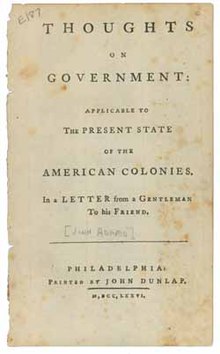
In 1776 John Adams was asked for suggestions on the form that the new colonial governments should take, and he responded with a treatise called Thoughts on Government, Applicable to the Present State of the American Colonies, in which he discussed the importance of having a bicameral rather than unicameral legislature.

American government is based on the principle that voters with incomplete information will make choices to elect flawed human beings to represent them, as all humans are. Systems of checks and balances are created throughout the system to counterbalance the natural limitations of humans in roles of leadership.

Image result for thoughts on governmentThe Founding Fathers worked with the idea of the Few and the Many. The Few constitute the influential, the monied, the connected, those who are familiar with the gears and levers of government. The Many constitute the the general population who simply wish to live their lives, raise their families, and pursue happiness.

Our state and federal government were created as they are so that one house (the Senate) might represent the Few, while the other (the House) represented the Many.

In Groton, we see in structure of our town government an absolutely beautiful example of bicameral governance on a local level. In Groton, there is a Town Council of 9 members elected at large, and a Representative Town Meeting (RTM) of 41 members elected among 7 districts.

Members of both bodies volunteer their time for the good of their community, but Town Councilors are expected to spend 15 hours and more every single week for what is ultimately a very thankless job. The RTM, by contrast, spends a few hours per month in meetings, except for during the month of May when they spend considerable time poring over every line of a 250 page budget.

Naturally, the pool of potential Town Councilors, individuals who have the talent to serve and the willingness to invest hundreds of unpaid hours, is quite a bit more limited than the pool of those who might serve on the RTM. The result is a difference in the character of the two bodies.

Town Councilors tend to be people of greater political involvement in the town and its history, which is multiplied once on the Council as they work closely with staff throughout the town. This is both an asset and a hindrance. It is an asset as their familiarity allows them to better understand the inner workings of our town. It is a hindrance as their increasing familiarity may cause them to overlook errors and inferior solutions, much as one ceases to notice a creaky step in their house after many years of living there.

41 regular citizens coming together for the benefit
of their community and their neighbors. There can be
no better representation of true republican democracy than
the New England town meeting.
Covering this blindspot is the relative enthusiasm and inexperience of the RTM members. For any given issue, some of the members are encountering it for the first time, giving them the opportunity to approach it with fresh eyes, possibly asking questions that have not been asked before, while others have decades of experience in government giving them a seasoned outsider perspective.

In the most extreme circumstances, the RTM can come together and even reverse actions of the Town Council or initiate their own actions. These tools are rarely employed, but their existence weighs into every decision that the Town Council makes.

All of the meetings of the Town Council and the RTM are recorded by Groton Municipal Television and uploaded to YouTube. Watch a couple Town Council meetings and contrast them to RTM meetings. Much of the work of the Town Council is done behind the scenes in caucuses and planning meetings. Their meetings are quick, efficient, and orderly, which is good for the conduct of business but often fail to allow the viewer to fully grasp the function of the government.

The RTM, by contrast, contains many members who are effectively members of the general public coming forward to serve their neighbors. They may have little more involvement in government affairs than anyone else living on their street, so the questions that they pose to the Town Manager, the Superintendent of Schools, or any other staff who come before the RTM are the questions of their neighbors. The RTM gives voice to every citizen, both through direct citizen comment and though their representatives.

The RTM is one of the most incredible tools of democratic engagement. The question may be posed as to whether the RTM has been employed to its best potential here in the town of Groton, but it is like any tool. It must be employed by motivated and skilled hands to create a beneficial result.

There can be no doubt that the mere capability of the RTM to veto an ordinance has caused the Town Council to give a second thought to a flawed ordinance.

There can be no doubt that items of the budget have been refined and cut prior to coming to the RTM, knowing that the RTM would reduce it if the Town Council did not.

There can be no doubt that the ability of the RTM to inquire has brought sunlight to many functions of our town.

There can simply be no doubt that the town of Groton, Connecticut is a better governed town because of the powerful direct influence that the RTM allows the common citizen to have on the government process.

Sunday, October 21, 2018

The Groton Charter Revision In Brief

On November 6th, Groton, Connecticut will vote on a proposed revision to the Charter which governs the structure of the town.

Presently, Groton has a 9 member Town Council and a 41 member (1 per 1000 residents) Representative Town Meeting. The Town Council is the seat of primary authority in the town. They have the power to create ordinances, develop the budget, and make contracts with employees among other powers.

The Representative Town Meeting reviews the budget line by line, approving or reducing the Town Council's proposal. They can also restore funding if the Council cut the Town Manager's or Board of Education's recommendations. The RTM has the power to veto ordinances of the Town Council and even the Power of Initiative to create their own.

It is effectively a bicameral legislature, with the Town Council as the upper house and the RTM as the lower house, with diminutive authority but providing a check on the power of the Town Council.

Groton's Right to Vote is the political action committee advocating for this revision, and you can find a summary of their arguments on their web site.

What's Changing
The main thing that the charter revision will do is eliminate the RTM and create a Finance Board and budget referendum. Rather than the Town Council creating a budget to be reviewed by the RTM, the Finance Board will work with the Town Manager to create a budget recommendation. The Town Council will then take that recommendation and craft the actual budget. This budget will then be voted on in a referendum.

The GRTV web site summarizes this as follows:
  • Gives citizens the right to vote on our annual budget, like they do in the City of Groton and the Towns of Stonington, East Lyme, Guilford, Clinton, Madison, Newtown, Cromwell and many other communities in CT.  Town and Education budgets are approved separately.
  • Greatly simplifies Town Government by eliminating the RTM, no other Town in Connecticut has a Town Council and an RTM like Groton has. 
  • Provides for a Board of Finance, a stand-alone elected body, to support the Town Council in financial matters and keep the public informed.
  • Provides for a transparent annual budget development process with many opportunities for citizen input including mandatory budget guidance by the Town Council.

What's not Changing

  • Maintains the Town Council/Town Manager form of government. Town Council, sets policy for the Town, elected at-large, stays at 9 members. Town Manager executes policy and runs the town. Virtually no change to the core of our town government.
  • The seven voting districts will remain as is.   No changes.
That might sound pretty good to some, but is it really?
All that sounds pretty good, doesn't it. I mean, who doesn't want the "right to vote?"

It's a little more complicated than that. In future articles, I'll be going into great depth on a number of these topics, but let's just spend a few moments on each of these points.

The Right to Vote
Image result for voting
Sprague just recently passed a budget after four months of
revotes. North Stonington once required 9 elections to pass
a budget. Groton could see similar problems.
They do indeed have budget referendums in many other towns, most of them smaller than Groton, and if you speak to people who live in those towns, you will find that most of them are quite disappointed with the results of this system. A town official from a local town explained that about ten years ago, there was a wave of charter revisions replacing town meetings with referendums, and almost without exception, the towns that have undergone such transitions regret their choice to do so. The election process creates uncertainty and unnecessary expense in the municipal governance process. Recently Sprague, a town of 2,900 people (compared to Groton's 41,000), took four months to pass a budget. North Stonington once took 9 votes to finally approve a budget. In small towns, a budget referendum only costs a few thousand dollars. In Groton, each vote will cost $20,000-$25,000

Massachusetts, which has town property taxes on average 1/3 what they are in Connecticut, has a town meeting in every town, but a referendum for any tax increase of more than 2.5%. This is called a Prop 2 1/2 Override. Thus, they are able to have an efficient and representative system of budget creation with a check against excessive tax increases. To many, this would seem to be a more reasonable, less costly form of a budget referendum for Groton to adopt, rather than the extreme version being proposed.

Greatly simplifies Town Government by eliminating the RTM
Simple government is not necessarily better government. The RTM provides an opportunity for ordinary citizens to participate in the government process. Whether a town has a council or board of selectmen, the close involvement of the town leadership with the day to day workings of the government can induce a form of groupthink, sometimes causing them to overlook obvious solutions or problems that an outsider might spot at once. The RTM is a simple and effective solution to this problem, allowing 41 engaged citizens to take a second look at all the major activities of the town.

Image result for founding fathers
The founding fathers intentionally created complexity
in government called checks and balances to ensure a
balance of power which would create stability and fairness.
Eliminating the RTM makes town government simpler and smaller in one way, but our government is intentionally built on a system of checks and balances. The President requires Senate approval for appointments. Congress must get a Presidential signature to pass a bill. The Judiciary may review the actions of either. In the same way, the RTM provides a check and review on the actions of the Town Council. Take away the RTM, and 5 members of the Town Council (a simple majority) have a lot more power with no check or balance.

Board of Finance and Transparent Annual Budget Process
An argument of GRTV is that the early part of the budget process is behind closed doors, led by department heads, and that by the time the budget reaches the Town Council and the RTM, much of it is already set. The GRTV supporters argue that the new charter will create public hearings earlier in the process as the Board of Finance has meetings to create the budget. However, the truth is members of the public can speak to the Town Council and RTM anytime, all year long, and the Council holds a public hearing on the budget before the budget process begins. It’s not so clear anything the BOF does will be different.  Furthermore, the BOF in Groton has no actual power or authority. They are “advisory” only. Groton will be the only town in the state with a BOF with no actual power or authority. In every other town that has a BOF, they have actual power.

Image result for contract negotiations
The RTM, along with the Town Council and Board of
Education can control staffing costs by reducing
positions, as they have done in the past.
The GRTV group argues that because the Town Council approves employee contracts, the RTM doesn’t have authority over the 80% of the budget that is employee costs.  Nothing could be further from the truth!  Most of the budget is made up of personnel costs, and those are based on contracts approved by the Town Council prior to the budget process. Only the Town Council and Board of Education approve contracts, and that won’t change with the new charter.

But, all three bodies, the Council, BOE and RTM can control overall employee costs (80% of the budget) by reducing positions, which has been done over the past two decades.  Many positions have been eliminated. Again, nothing will change in this regard, with the new charter. The claim that the RTM can’t act on 80% of the budget is inaccurate.

Virtually no change to the core of our town government
It is a bold statement to suggest that the elimination of a 41 member elected representative body constitutes "virtually no change to the core of our town government." The RTM not only reviews the budget, but reviews ordinances, financial transfers, and other town activities. Beyond the official powers of the RTM, the RTM creates a method for 41 additional members of the community to be involved in their town's government, and to provide oversight of every activity of the town. That's 41 more sets of eyes to notice potential cost savings. 41 more people to spot errors or even malfeasance. 41 more people keeping an eye on the cookie
jar. Many of these people become interested enough to go further and later run for Town Council or Board of Education. We lose the valuable learning opportunity for residents who want to be involved but cannot necessarily commit to weekly meetings all year long.


41 citizens getting involved, providing oversight, creating
solutions, identifying problems, and keeping an eye on
the cookie jar.
In the next few weeks leading up to the November 6th vote, I will be writing a series of articles to provide additional background and information on various aspects of the proposed revision.

You see, I came to this issue at first with not particular interest one way or the other, but the more I researched and studied, the more I found that our current system of government, while not perfect (what system is?), has an incredible elegance in its system of checks and balances. I have found the proposed charter revision to be unrefined, unfinished, and undesirable for the future of our town, and I believe that as I share what I have learned with you, you will come to agree with me that this revision should be rejected.

Groton's charter is not perfect, and revisions may be needed, but this revision, the one before us in November, is not the right choice for Groton.

Michael Whitehouse presently serves a representative on the Representative Town Meeting from the Fourth District. His opinions do not represent any official stance of the town of Groton. His opinions are his alone, but he hopes that you may find them compelling enough to share them.

Saturday, May 5, 2018

What David Collins Doesn't Know About Downtown Groton

"I never knew Groton had a downtown." This is how David Collins started his column in yesterday's edition of The Day, prompted by the new signage that is now up on Interstate 95, discussed briefly in this article.

For those who are not familiar with Groton, Connecticut, it is a town with unusual geography. In the 19th century, it was split between Groton Bank, which was the portion of Groton on the bank of the Thames River, which was densely populated and supported by the shipping industry, and the town of Groton, which was the rest of the town's 45 square miles, was sparse farmland with occasional villages.

Annotated map of Groton from Google Maps.
Apologizes for the business pins. No way to remove the ads.
As it developed, an area around Long Hill Road near exit 87 off I-95, just outside of Groton City, which Groton Bank would ultimately come to be called, became a center of shopping and commerce. The proximity to the highway, I presume, made it an attractive location for mid-century developers, providing the five strip malls which dominate the area now known as Downtown.

A short way further down that road, one finds Town Hall, the major town field Poquonnock Plains Park, the Public Library, Groton Recreation Building, and the Groton Senior Center, which forms something of a municipal district.

Zoomed in on Downtown Groton. This map is about a mile
from one end to the other. Town Hall is at the far right.
Long Hill Road is at the far left.
As my regular readers may have notices, I love dictionary definitions.

down·town
ˌdounˈtoun/
NORTH AMERICAN
adjective
adjective: downtown
  1. 1.
    of, in, or characteristic of the central area or main business and commercial area of a town or city.

    "downtown Chicago"

    synonyms:centralmetropolitanmetrourbanMore
adverb
adverb: downtown
  1. 1.
    in or into a downtown area.

    "I drove downtown"
noun
noun: downtown; plural noun: downtowns
ˈdountoun/
  1. 1.
    the downtown area of a town or city.

    "the heart of Pittsburgh's downtown"

    synonyms:city center, (central) business district, urban core; More

While we often think of Downtown as referring to an urban center, "Downtown" is really just the core of business and commercial activity in the area, which is what Groton's "Downtown" is, thus why it is called Downtown Groton. While towns like New London, Norwich, and Westerly have more traditional 19th century style downtowns, Groton, like Waterford, has a post-war style downtown area, built along the 1950s and 1960s concepts of separating various forms of zoning to different parts of town: commercial here, residential there, industrial in the other place.

Long Hill Road is affectionately referred to as Hamburger
Hill, because there are actually at least half a dozen
places along the short stretch of road to get a hamburger.
Some of the burgers are better than others.
As it turns out, that form of zoning creates a dependency on cars, prevents neighbors from interacting, and generally causes a colder, less connected community, but that's a story for another day. The point is that Groton has what it has, and what it has is a vibrant, thriving, suburban-style downtown area.

Downtown Groton contains 5 main shopping plazas plus a number of other freestanding businesses and smaller plazas. Within and near Downtown, a shopper can find nearly anything they seek, including groceries, clothes, Post Office, auto dealerships, a hardware store, hobbies and entertainment, pet supplies, and more.

Is it a beautiful area with quaint New England charm? No. Is it a downtown hub of commercial activity, absolutely.

Citadel Game Cellar has something
going on almost every day.
While it largely lacks mixed use development (two small mixed used developments are in the downtown area), and its suburban nature would stretch the definition of the term "walkable," I often walk the area. I frequently walk from my apartment to the Citadel Game Cellar, one of the best game stores I have found in the country, with events happening almost every day.

While Downtown Groton leaves quite a bit to be desired, it's not an embarrassment either, bringing millions of dollars of economic activity to the town and tremendous revenues onto the tax rolls.


In discussing the Downtown designation, Mr. Collins says:
It turns out, I discovered after a search of the town website, the term downtown used for that section of Route 1 was sealed in a 2006 planning study for the town, which envisioned all kinds of mixed-use development around the old shopping centers — development that, of course, never happened.
The Groton Strategic Development Plan envisioned that construction of more housing and an effort to make the area more "walkable" would transform the area that the study authors conceded, because of its age and design, "can no longer compete as a traditional suburban-style shopping destination." 
So, as the authors note, it is a tired, old shopping district. And all the development they envisioned that would make it into a downtown has never happened. Still, that's the downtown interstate travelers will be directed to, about the worst of what Groton has to offer.
Let's talk about what we can find in the "worst of what Groton has to offer."

In this stretch you can find American, Mexican, Indian, Thai, Japanese, and Chinese food.

This one plaza has Indian, Japanese, and Thai food, plus an
Indian grocery store.
The newly refurbished Groton Shopping Center is 100% occupied, including a well balanced mix of businesses.
In this plaza, you can work out, buy groceries, buy clothes,
and get a new set of spark plugs.
Even the most run down of Downtown Groton's plazas, Groton Shoppers Mart, contains many of the key businesses that, while not revolutionary, are the backbone of a commercial district: Big Y, Starbucks, and Gamestop. Even though the properly is somewhat in limbo because of owners who cannot agree on what should be done with it, it still maintains a relatively high occupancy because of the demand for businesses to serve the growing economy of Groton.

Groton Shoppers Mart suffers from having too many owners
who cannot agree on how to manage, improve or sell it, so
it just kind of exists.
For those who are not familiar with redevelopment initiatives, they tend to move slowly. This is partly because they are complex and involve many players, and partly because there are many ways that they can go fantastically wrong.

There are basically two ways to cause redevelopment occur on privately held, developed land. The town can create incentives and try to get buy-in from the land owners, or they can try to use eminent domain to claim the property and force the changes. The eminent domain solution has certain problems.

Certain problems with eminent domain.
That means that the developers have to want to make the change. It takes years to research and develop a plan, then there is the process of getting buy-in from the land owners. Then it takes years more to make the plans to implement it, financing must be raised, and finally action is taken.

Did anything happen within the years shortly after 2006 that might have deterred that process?

Oh, yeah, that.
I didn't move to Groton until 2014, so I don't know the full details of what happened around that time, but, given that the Economic Development Commission and the Office of Planning and Development are working to execute today that very same concept of mixed use development and modernization in Downtown, I would surmise that what we are seeing is simply a situation in which a good idea is moving at the speed of government, interrupted by a terribly inconvenient financial crisis that rivaled the Great Depression.

Downtown Groton is the second area of the town that will become a Tax Increment Financing (TIF) district in order to help finance these developments. TIF is a brilliant policy in which future tax revenues can be used as guarantees against loans for infrastructure necessary for development. The financing is procured by the developers, not the town, and the developer is responsible for it, but they are able to use a portion of the increased tax revenues to pay off the loans. The town only pays if the development happens and the tax revenues increase. The developer gets the loan paid for them as long as they hold up their part. Everyone wins, most of all the people of Groton win.

It must be very difficult to write a weekly column, which would explain why Mr. Collins failed to do even the most basic research into the current situation. Research which could have included asking his colleague who wrote an article on the EDC tour which ran in the same issue as his column.

I wouldn't know what it's like to write a weekly column like that. I only have experience writing a daily one.